For research use only. Not for therapeutic Use.
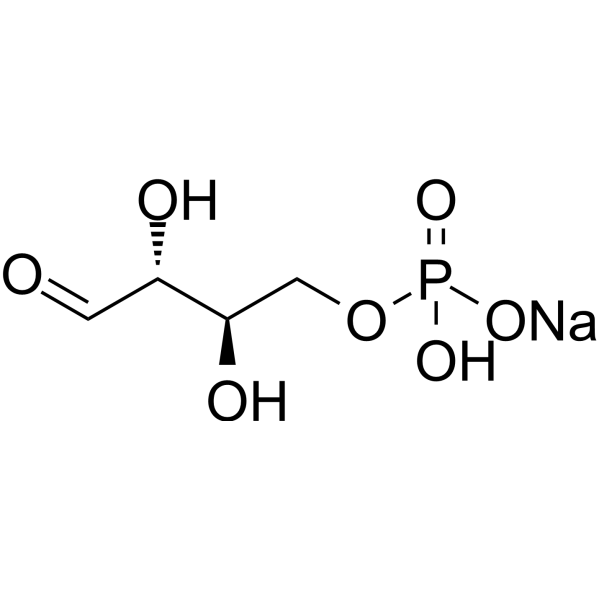
D-Erythrose 4-phosphate sodium is a phosphate sodium of the simple sugar Erythrose. Erythritol is actually converted into D-Erythrose 4-phosphate that involves three isomerases[1].
Erythritol is a preferential substrate for Brucella. Erythritol is actually converted into D-erythrose-4-phosphate through a set of reactions that involves three isomerases and that allows hexose-monophosphate synthesis and growth by feeding the pentose phosphate shunt[1].
| CAS Number | 103302-15-4 |
| Synonyms | sodium;[(2R,3R)-2,3-dihydroxy-4-oxobutyl] hydrogen phosphate |
| Molecular Formula | C4H8NaO7P |
| Purity | ≥95% |
| InChI | InChI=1S/C4H9O7P.Na/c5-1-3(6)4(7)2-11-12(8,9)10;/h1,3-4,6-7H,2H2,(H2,8,9,10);/q;+1/p-1/t3-,4+;/m0./s1 |
| InChIKey | KKDBADMPNGAKHM-RFKZQXLXSA-M |
| SMILES | C(C(C(C=O)O)O)OP(=O)(O)[O-].[Na+] |
| Reference | [1]. Barbier T, et al. Erythritol feeds the pentose phosphate pathway via three new isomerases leading to D-erythrose-4-phosphate in Brucella. Proc Natl Acad Sci U S A. 2014 Dec 16;111(50):17815-20. |
| Chemistry Calculators | Dilution Calculator In vivo Formulation Calculator Molarity Calculator Molecular Weight Calculator Reconstitution Calculator |